
Disclaimer: This article is intended solely for informational and educational purposes only. It does not constitute medical advice.
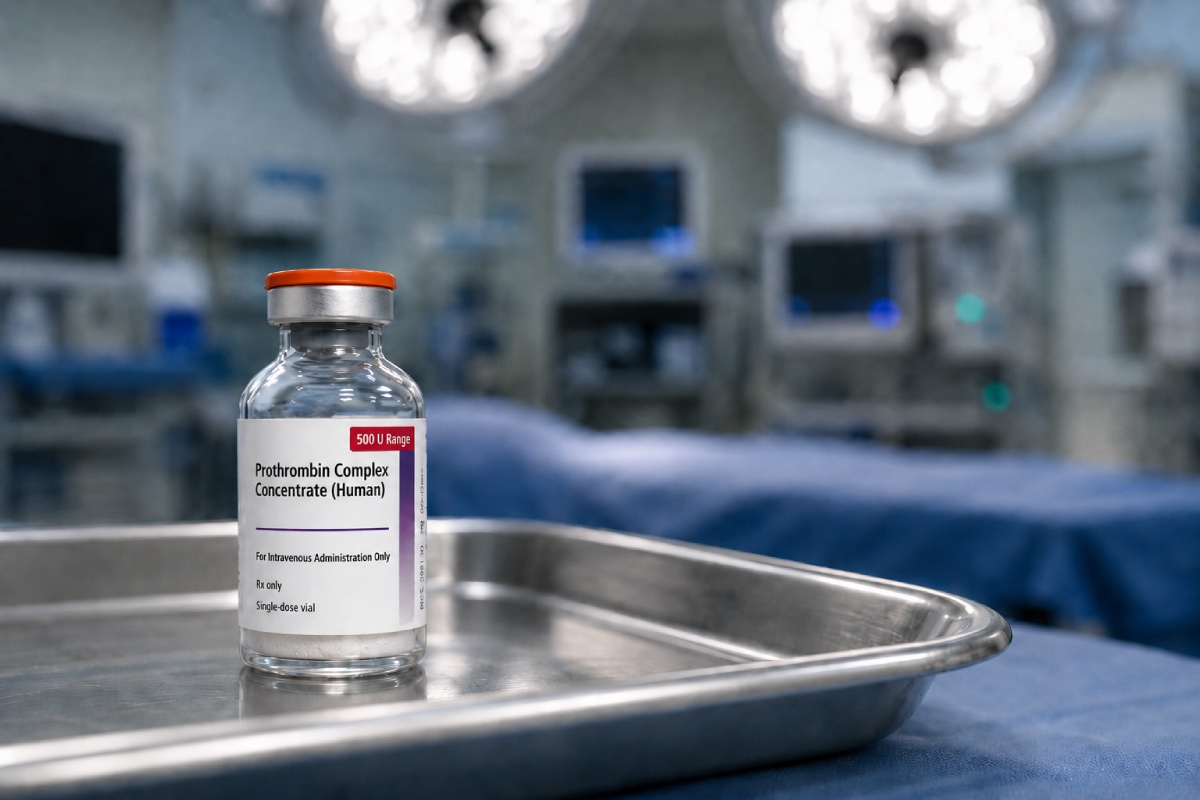
Perioperative use of prothrombin complex concentrate (PCC) has become an important component of modern bleeding management for patients requiring urgent surgery or experiencing significant perioperative hemorrhage. PCC is a plasma-derived concentrate containing the vitamin K-dependent clotting factors II, VII, IX, and X. Compared with fresh frozen plasma (FFP), PCC can be administered more rapidly, requires less infusion volume, and does not require blood type matching. These characteristics allow faster correction of clotting factor deficiencies while reducing complications associated with large-volume plasma transfusions, making PCC particularly valuable when timely hemostasis is essential (1).
The most well-established indication for PCC is the rapid reversal of warfarin anticoagulation in patients requiring emergency surgery or other urgent invasive procedures. Because warfarin prolongs the international normalized ratio (INR), patients remain at increased risk of excessive bleeding until clotting factor levels are restored. Administration of four-factor PCC together with intravenous vitamin K has consistently been shown to normalize the INR more rapidly than FFP while providing effective hemostasis. PCC also avoids the delays associated with plasma thawing and reduces the risk of transfusion-associated circulatory overload because substantially less infusion volume is required (2).
Prothrombin complex concentrate also helps manage severe perioperative bleeding, particularly during cardiac surgery. Cardiopulmonary bypass can dilute clotting factors and impair normal coagulation, contributing to significant postoperative hemorrhage. In patients with persistent bleeding despite conventional blood component therapy, PCC rapidly replaces multiple clotting factors. Evidence indicates that PCC can reduce allogeneic blood transfusion requirements and improve bleeding control without consistently increasing mortality or major thromboembolic complications. Although much of the available evidence comes from observational studies, current findings support PCC as an effective adjunct in appropriately selected patients (3).
Direct oral anticoagulants (DOACs) are now widely used for the prevention and treatment of thromboembolic disease, which makes perioperative management of anticoagulated patients a common clinical challenge. Although specific reversal agents are available for certain DOACs, they may not always be readily available or appropriate in every clinical setting. In these situations, PCC is commonly used to improve hemostasis before emergency surgery or during life-threatening bleeding, particularly in patients receiving factor Xa inhibitors. While PCC does not completely reverse the anticoagulant effect of these medications, clinical studies demonstrate that it can improve clot formation and contribute to effective bleeding control when rapid intervention is necessary (4).
Despite its clinical benefits, PCC should be administered thoughtfully because it contains concentrated procoagulant factors that may increase the risk of thromboembolic events. Contemporary studies have generally reported low rates of complications such as deep vein thrombosis, pulmonary embolism, myocardial infarction, and ischemic stroke when PCC is used appropriately. Nevertheless, clinicians should carefully consider each patient’s thrombotic risk, including a history of previous thromboembolism, cardiovascular disease, malignancy, or mechanical heart valves. Weight-based dosing and laboratory assessment remain essential to achieving effective hemostasis while minimizing adverse events (4).
Current perioperative bleeding management increasingly incorporates PCC into goal-directed transfusion strategies that combine clinical assessment with coagulation testing to guide therapy. This approach aims to rapidly correct clotting factor deficiencies while avoiding unnecessary transfusions. Although additional randomized studies are needed to define optimal dosing strategies, current evidence supports prothrombin complex concentrate as a safe, effective, and efficient therapy for urgent warfarin reversal and selected cases of severe perioperative bleeding.
References
- Levy JH, Douketis J, Steiner T, Goldstein JN, Milling TJ. Prothrombin Complex Concentrates for Perioperative Vitamin K Antagonist and Non-vitamin K Anticoagulant Reversal. Anesthesiology. 2018;129(6):1171-1184. doi:10.1097/ALN.0000000000002399
- Sarode R, Goldstein JN, Simonian G, et al. Vitamin K Antagonist Reversal for Urgent Surgery Using 4-Factor Prothrombin Complex Concentrates: A Randomized Clinical Trial. JAMA Netw Open. 2024;7(8):e2424758. Published 2024 Aug 1. doi:10.1001/jamanetworkopen.2024.24758
- Roman M, Biancari F, Ahmed AB, et al. Prothrombin Complex Concentrate in Cardiac Surgery: A Systematic Review and Meta-Analysis. Ann Thorac Surg. 2019;107(4):1275-1283. doi:10.1016/j.athoracsur.2018.10.013
- Tanaka KA, Shettar S, Vandyck K, Shea SM, Abuelkasem E. Roles of Four-Factor Prothrombin Complex Concentrate in the Management of Critical Bleeding. Transfus Med Rev. 2021;35(4):96-103. doi:10.1016/j.tmrv.2021.06.007